3 new iOS 9.3 features business users will love

iOS 9.3 offers several features that might appeal to business-oriented Apple users.

Apple introduced a new version of iOS on Monday. The update includes several new features, including updates to CarPlay and HealthKit, as well as a feature to make it easier for iPads to be used in schools for educational purposes. There are several other new features which are particularly appealing to the business-oriented user.

Here are 3 new features business users should check out.

ios93SJTechies

Night Shift

The proliferation of devices like tablets and smartphones means that some sort of screen is never far away. For many, looking at a screen is the first and last thing they do in the morning and evening.

The problem with that is screens emit blue light, which reduces the amount of melatonin produced in the body. Melatonin is a chemical that helps people fall asleep. The light emitted from smartphones can also cause eye strain, which carries symptoms like headaches and blurred vision.

With this latest version of iOS 9, Apple introduced Night Shift, a feature that automatically adjusts the colors of your display at night. You can schedule times for it to go into effect, manually turn it on and off, and adjust colors on a scale of less warm to more warm.

You can access Night Shift through Settings | Display & Brightness, or through the menu that swipes up from the bottom of the device’s screen.

ios9SJTechies

Password-protected Notes

Notes is iOS’ app for taking, well, notes. iOS 9.3 updates it by allowing users a layer of security. Now, users can lock their notes using either a password or the Touch ID, which makes the app that much more useful.

In order to lock a note, tap the button in the top right corner (the one you might use if you were going to email the note) and then tap Lock Note. When prompted, enter a password, confirm it, and decide if you want to enable the Touch ID. A lock button will appear at the top of the note and in the future if you want to open it, enter the password or use the Touch ID.

ios92SJTechies

More personalized News

The News app now offers more personalization for users, and on a range of topics and publications. So for example, you can select a topic like mobile apps or internet privacy. You can access news by opening the News app, or by swiping right from your main screen.

Have questions?

Get answers from Microsoft Cloud Solutions Partner!
Call us at: 856-745-9990

TECHIES is a full Managed IT Services Company headquartered in Marlton, New Jersey for over 20 years with a new location opening soon in Wilson, North Carolina. TECHIES provides Managed IT Services, Cybersecurity Solutions, Website Design ServicesDedicated Server SolutionsIT ConsultingVoIP Phone SolutionsCloud Solutions, Network Cabling and much more.

Beware downloading some apps or risk “being spied on”

Popular apps on your smartphone can be convenient and fun, but some also carry malicious software known as malware, which gives hackers easy access to your personal information.

A security firm found that between 75 and 80 percent of the top free apps onAndroid phones or iPhones were breached. The number jumps as high as 97 percent among the top paid apps on those devices.

Whether these apps help advertisers target you or help hackers rip you off, you’ll want to do your homework before downloading apps, reports CBS News correspondent Anna Werner.

California’s Susan Harvey said she was a victim after she used a debit card to download a slot machine game app to her cell phone through a Google Play store account.

“It was something you purchased once, for like $15,” Harvey said.

When she went to reload the game, she found hundreds of purchases had been made — by her math, more than $5,000 worth of transactions.

“My heart sank, I just sat there looking at it… I physically, I was sick, because I didn’t know what they were,” Harvey said.

That story’s no surprise to cybersecurity expert Gary Miliefsky, whose company SnoopWall tracks malware. He said certain apps are designed to steal your personal information.

“What are the consequences for me as a consumer?” Werner asked.

“You’re gonna lose your identity. You’re gonna wonder why there was a transaction. You’re gonna wonder how someone got into your bank account and paid a bill that doesn’t exist,” Miliefsky said.

Milifesky said when you download an app, you also give permission for it to access other parts of your phone, like an alarm clock app that can also track phone calls.

“You think an alarm clock needs all those permissions? Access to the Internet over wifi, your call information, calls you’ve made, call history, your device ID? This to me is not a safe alarm clock,” Miliefsky said.

And there’s the weather and flashlight apps that he says exploit legitimate banking apps to capture information, as he showed us in a demonstration of what could happen when someone takes a photo of a check to send to their bank.

“The flashlight app spies on the camera and noticed the check and grabbed a copy of it. Shipped it off to a server somewhere far away,” Miliefsky said.

Last year the group FireEye discovered 11 malware apps being used on iPhones that gathered users’ sensitive information and send it to a remote server, including text messages, Skype calls, contacts and photos Apple fought back by removing the apps and putting stricter security measures in place.

“They get at your GPS, your contacts list…to build a profile on you,” Miliefsky said.

Some apps are simply collecting information for advertising purposes. In 2014, the Federal Trade Commission settled a lawsuit with a company over its popular Brightest Flashlight app, alleging it transmitted consumers’ personal information to third parties without telling them.

But Miliefsky said he’s found another flashlight app that can do much more troubling things.

“This one turns on your microphone in the background, listens in on you, and sends an encrypted tunnel to a server we discovered in Beijing,” Miliefsky described.

“You’re saying that they’re actually listening to people’s conversations and sending that audio back to Beijing?” Werner asked.

“Yeah, we’ve tracked it. I can show you where it does it,” he said.

Miliefsky said it can be traced to a few blocks from Tiananmen Square on Information Drive in Beijing.

He gave a report on that app to the FBI.

“Because to me, it’s spyware at the nth degree,” Miliefsky said.

His recommendation?

“We really have to look at our phone and say, ‘This is really a personal computer that fits in our pocket. Let’s shut down all the apps we don’t use. Let’s delete apps that don’t make sense and reduce the risk of being spied on,'” Miliefsky said.

The creator of the Brightest Flashlight app settled with the FTC, agreeing to change its policy and delete all the information it had gathered.

Harvey sued Google over her alleged hack, but a judge recently dismissed it, saying she and her attorney filed too late. Google said fewer than one percent of Android devices got bad apps in 2014.

Have questions?

Get answers from a Microsoft Cloud Solutions Partner!
Call us at: 856-745-9990

TECHIES is a full Managed IT Services Company headquartered in Marlton, New Jersey for over 20 years with a new location opening soon in Wilson, North Carolina. TECHIES provides Managed IT Services, Cybersecurity Solutions, Website Design ServicesDedicated Server SolutionsIT ConsultingVoIP Phone SolutionsCloud Solutions, Network Cabling and much more.

Apple CEO Tim Cook: FBI asked us to build a back door into iOS

The most important Tech Case in a Decade

Customer Letter – Apple

February 16, 2016

A Message to Our Customers

The United States government has demanded that Apple take an unprecedented step which threatens the security of our customers. We oppose this order, which has implications far beyond the legal case at hand.

This moment calls for public discussion, and we want our customers and people around the country to understand what is at stake.

Answers to your questions about privacy and security

The Need for Encryption

Smartphones, led by iPhone, have become an essential part of our lives. People use them to store an incredible amount of personal information, from our private conversations to our photos, our music, our notes, our calendars and contacts, our financial information and health data, even where we have been and where we are going.

All that information needs to be protected from hackers and criminals who want to access it, steal it, and use it without our knowledge or permission. Customers expect Apple and other technology companies to do everything in our power to protect their personal information, and at Apple we are deeply committed to safeguarding their data.

Compromising the security of our personal information can ultimately put our personal safety at risk. That is why encryption has become so important to all of us.

For many years, we have used encryption to protect our customers’ personal data because we believe it’s the only way to keep their information safe. We have even put that data out of our own reach, because we believe the contents of your iPhone are none of our business.

The San Bernardino Case

We were shocked and outraged by the deadly act of terrorism in San Bernardino last December. We mourn the loss of life and want justice for all those whose lives were affected. The FBI asked us for help in the days following the attack, and we have worked hard to support the government’s efforts to solve this horrible crime. We have no sympathy for terrorists.

When the FBI has requested data that’s in our possession, we have provided it. Apple complies with valid subpoenas and search warrants, as we have in the San Bernardino case. We have also made Apple engineers available to advise the FBI, and we’ve offered our best ideas on a number of investigative options at their disposal.

We have great respect for the professionals at the FBI, and we believe their intentions are good. Up to this point, we have done everything that is both within our power and within the law to help them. But now the U.S. government has asked us for something we simply do not have, and something we consider too dangerous to create. They have asked us to build a backdoor to the iPhone.

Specifically, the FBI wants us to make a new version of the iPhone operating system, circumventing several important security features, and install it on an iPhone recovered during the investigation. In the wrong hands, this software — which does not exist today — would have the potential to unlock any iPhone in someone’s physical possession.

The FBI may use different words to describe this tool, but make no mistake: Building a version of iOS that bypasses security in this way would undeniably create a backdoor. And while the government may argue that its use would be limited to this case, there is no way to guarantee such control.

The Threat to Data Security

Some would argue that building a backdoor for just one iPhone is a simple, clean-cut solution. But it ignores both the basics of digital security and the significance of what the government is demanding in this case.

In today’s digital world, the “key” to an encrypted system is a piece of information that unlocks the data, and it is only as secure as the protections around it. Once the information is known, or a way to bypass the code is revealed, the encryption can be defeated by anyone with that knowledge.

The government suggests this tool could only be used once, on one phone. But that’s simply not true. Once created, the technique could be used over and over again, on any number of devices. In the physical world, it would be the equivalent of a master key, capable of opening hundreds of millions of locks — from restaurants and banks to stores and homes. No reasonable person would find that acceptable.

The government is asking Apple to hack our own users and undermine decades of security advancements that protect our customers — including tens of millions of American citizens — from sophisticated hackers and cybercriminals. The same engineers who built strong encryption into the iPhone to protect our users would, ironically, be ordered to weaken those protections and make our users less safe.

We can find no precedent for an American company being forced to expose its customers to a greater risk of attack. For years, cryptologists and national security experts have been warning against weakening encryption. Doing so would hurt only the well-meaning and law-abiding citizens who rely on companies like Apple to protect their data. Criminals and bad actors will still encrypt, using tools that are readily available to them.

A Dangerous Precedent

Rather than asking for legislative action through Congress, the FBI is proposing an unprecedented use of the All Writs Act of 1789 to justify an expansion of its authority.

The government would have us remove security features and add new capabilities to the operating system, allowing a passcode to be input electronically. This would make it easier to unlock an iPhone by “brute force,” trying thousands or millions of combinations with the speed of a modern computer.

The implications of the government’s demands are chilling. If the government can use the All Writs Act to make it easier to unlock your iPhone, it would have the power to reach into anyone’s device to capture their data. The government could extend this breach of privacy and demand that Apple build surveillance software to intercept your messages, access your health records or financial data, track your location, or even access your phone’s microphone or camera without your knowledge.

Opposing this order is not something we take lightly. We feel we must speak up in the face of what we see as an overreach by the U.S. government.

We are challenging the FBI’s demands with the deepest respect for American democracy and a love of our country. We believe it would be in the best interest of everyone to step back and consider the implications.

While we believe the FBI’s intentions are good, it would be wrong for the government to force us to build a backdoor into our products. And ultimately, we fear that this demand would undermine the very freedoms and liberty our government is meant to protect.

TECHIES is a full Managed IT Services Company headquartered in Marlton, New Jersey for over 20 years with a new location opening soon in Wilson, North Carolina. TECHIES provides Managed IT Services, Cybersecurity Solutions, Website Design ServicesDedicated Server SolutionsIT ConsultingVoIP Phone SolutionsCloud Solutions, Network Cabling and much more.

Safari on iOS and Mac crashing, bug related to Safari Suggestions, here’s how to fix

A strange bug is affecting many Safari users today, causing crashes on iPhone, iPad and Mac. For many users, simply tapping in the URL bar will cause the browser app to crash completely.  The exact issue causing the crashing has not been locked down, but it appears to be related to Apple’s Safari Suggestions service. It’s a very annoying bug that is affecting a lot of people all of sudden today.

sjt-blog-safari-crash-ios

When you type a URL, Apple sends what you type to its servers, returning a response with autocomplete search queries, Top Sites and other info. There appears to be a bug in this server request that is causing Safari to randomly crash. Users are discovering some potential workarounds until Apple fixes the problem properly …

Disabling Safari Suggestions seems to be helping resolve the bug for many people on iOS. On your iPhone or iPad, go into Settings, tap Safari, and toggle off the ‘Safari Suggestions’ switch. This will fix the crashing, obviously its only a temporary fix until Apple sorts its servers out as it will disable the Safari Suggestions functionality.

Another option is to enter Private Browsing mode. In private browsing, by design Safari does not contact the suggestions server for intelligent completion options, so the server is never contacted and the crash never arises.

The bug is affecting users in many countries, but not all. It also depends on the state of your Safari, whether it has certain data cached already. The crash has been seen on iOS 8, iOS 9 and OS X 10.11. The bug could be even more widespread beyond these platforms however. It is pretty crazy flaw that is affecting so many people this morning, with many reports across European iOS customers.

We have contacted Apple about the issue for clarification, but it’s such a serious functional flaw that we expect a fix very shortly. Please note: this is an unrelated incident to the prank site CrashSafari.com.

Update: The Safari crash bug has now been fixed, according to Apple.

Have questions?

Get help from IT Experts/Microsofts Cloud Solutions Partner
Call us at: 856-745-9990 or visit: https://southjerseytechies.net/

South Jersey Techies, LL C is a full Managed Web and Technology Services Company providing IT Services, Website Design ServicesServer SupportNetwork ConsultingInternet PhonesCloud Solutions Provider and much more. Contact for More Information.

To read this article in its entirety click here.

CES 2016: Fitbit launches $200 Apple Watch competitor

Step aside, Apple, there’s a new watch in town. At CES 2016, Fitbit unveiled the Blaze, a smartwatch that does things the Apple Watch can’t, and at a lower price point.

The basic utilitarian look of Fitbit is so last week, with today’s CES 2016 debut of Fitbit Blaze, a smart fitness watch with a color touchscreen that heralds in the next generation of the company’s popular fitness device line.

Fitbit Blaze does many of the same things as more expensive smartwatches, such as the Apple Watch, but it does it at a lower price point. The basic Fitbit Blaze comes with an elastomer band and will be available for retail sales in March 2016 with a $199 price tag. It tracks fitness and sleep stats and provides notifications for calls, texts, calendar alerts and music control. It’s compatible with Windows, iOS, and Android platforms.

One of the main features of the watch is how the bands are interchangeable to go from the gym to the office and out for the evening. Accessories will include additional elastomer bands for $29.95 each, leather bands for $99.95 each, and a steel link band for $129.95 each. The device is available for presale beginning today at Fitbit.com and tomorrow at various major retailers. For those who want to see the watch in person before ordering, on February 20 customers can go into Best Buy to try on the watch and pre-order.

“The product is about the balance of fitness and style. While it may look like a smartwatch, we think we’ve gotten it right. It has a distinct focus on fitness. That’s why we’re calling it a smart fitness watch. It puts fitness first,” said James Park, CEO and co-founder of Fitbit, at the CES 2016 press conference.

Fashion and style have long been a sore spot in the world of wearables and smartwatches. Because, even if a device has a stylish appearance, oftentimes it’s not feasible to wear the same product 24/7 for every occasion. The Fitbit Blaze eliminates this issue with the range of affordable interchangeable bands.

Fitbit Blaze includes many of the same features as previous Fitbit wearable fitness devices, such as all-day activity stats, but it also includes a color touchscreen, along with a partnership with FitStar for an onscreen workout. It also includes connected GPS for real-time exercise stats and PurePulse wrist-based heart rate tracking, which the company introduced last year.

The watch has a substantial battery life, lasting up to five days and nights, according to Fitbit Chief Business Officer Woody Scal.

Park said the Fitbit Charge, which was introduced last year, is the number one selling activity tracking device in North America, and the Fitbit Surge is the number one selling GPS tracking watch. On Christmas Day and the day after, Fitbit was the number one free app download.

“We are one of the larger technology IPOs of 2015. We are still trading about offering price which we think is rare. We’re pretty proud of that,” Park said.

Park took the opportunity at the press conference to point out how Fitbit is mentioned in the media, such as numerous photos with President Obama wearing a Fitbit Surge.

“For me it’s been really fun to see Fitbit mentioned on popular TV shows such as Big Bang Theory,” he said.

One of the biggest challenges that Fitbit faces is that its products have a 50% abandonment rate, compared to 6% for the Apple Watch. That makes the Blaze a strategically important move for Fitbit. The early reaction to the Blaze has been mixed as Fitbit’s stock dropped 13% following the announcement.

Have questions?

Get help from IT Experts/Microsofts Cloud Solutions Partner
Call us at: 856-745-9990 or visit: https://southjerseytechies.net/

South Jersey Techies, LL C is a full Managed Web and Technology Services Company providing IT Services, Website Design ServicesServer SupportNetwork ConsultingInternet PhonesCloud Solutions Provider and much more. Contact for More Information.

To read this article in its entirety click here.

New Apple TV release date, specs, price and news

For the fourth generation Apple TV, the possibilities are endless

Update: The new Apple TV is finally here and available to buy right now in all Apple Stores. Here’s the final pricing: $149 and $199 pricing for the 32GB and 64GB versions in the US respectively, £129 and £169 in the UK, while in Australia the cost is AU$269 and AU$349 for the different versions.
Apple TV


Original story below…

Three years of waiting for a major upgrade and six months of rumors have lead to this point: the new Apple TV, announced earlier in September at the company’s iPhone 6S event.

When it came time to think about the upgrade to the Cupertino company’s seminal streamer, it seems one Steve Jobs-ian point made it through the chopping board: the new Apple TV needs to be just as smart if its predecessor and just as easy to use. It needs to offer a slew of contemporary features but still remain relatively clean looking.

Perhaps unsurprisingly, the new Apple TV is all of those things.

Now, before you go down into the comments and leave a nasty retort, we know that “new Apple TV” is a fairly confusing name. But Apple bows to no numerical and/or logic system, and since the Apple TV has yet to see a true sequel until now, instead receiving iteration after iteration of internal upgrades, this is just the way the Apple peels.

It’s been about two years since the last minor change to the Apple TV and three since the last major one. Which, for a company that’s bound and determined to release a new iPhone every 12 months, seems a little strange that Apple’s popular streamer has been MIA since the iPhone 5.

But our patience has been rewarded, and Apple has delivered the next iteration of a great streaming device. It packs a faster processor than its predecessor, a great-looking UI, too. It has an all-new remote that comes with a built-in microphone and works with Siri, not to mention the fact that it doubles as a Wii-like motion game controller.

It has a sharp new OS – a hybrid of OSX and iOS – and comes with a loaded app store that Tim Cook says will usher in a new age of television. It’s ostentatious and bold vision packed into a tiny box. But that’s Apple for you.

Cut to the chase
What is it? The next generation of Apple’s set-top box, the Apple TV
When is it out? Monday October 26 2015 in over 80 countries worldwide
How much does it cost? The 32GB version will cost $149 (£129, AU$269) while the 64GB version will come in at $199 (£169, AU$349)
Why is it better? It has a faster processor, better interface, more apps, a Wii-esque remote and has voice search functionality

When WWDC 2015 came and went without an Apple TV announcement, we were a little disappointed. But when rumors started to circulate about the Cupertino company’s September 9 event, our hopes and dreams for a brand-new set-top box started to solidify into reality. It turns out it wasn’t all wishful thinking, either. Rumors of Apple’s next set-top box practically boiled over until most, if not all, of the Apple’s big secrets saw the light of day before the 9th. (You can find the key points highlighted in bold!)

New Apple TV user interface

User interfaces are absolutely crucial, and Apple built its reputation on putting together some of the sleekest, most easy-to-use pieces of software on the market. The new Apple TV harnesses that long tradition of doing things right and wildly improves the old model’s layout into something more modern.

The new UI is purposefully flat, with top-level boxes for music and movies on the iTunes store, your most used apps like Netflix and Hulu, as well as the recently added App Store – which is like to pack TV-optimized games alongside Apple Music and its music-streaming kin.

It’s all built on top of a new OS called tvOS that works like a hybrid of iOS and OSX. There are 11 million developers on the platform according to Apple senior vice president of Internet Software and Services, Eddy Cue, which means you can expect a ton of third-party apps available on the first day.

tvOS will support Siri and include universal search results that enable searches across multiple streaming video services as well as Apple’s iTunes Store. That means instead of searching for a movie on each individual app, you’ll be able to see a select number of services in every search (think Netflix, Amazon Prime Instant Video, Hulu, YouTube, Vimeo, etc).

New Apple TV remote

Also, we know that the New Apple TV will include an updated remote control (goodbye, boring aluminum IR remote) that operates over Bluetooth and features a mix of physical buttons and a touchpad.

Inside the remote, Apple looks to be packing in some Wii-esque motion sensors, which would make playing games on the App Store that require tilt easy. Speaking of Bluetooth, we’ve heard whispers that you might be able to connect any console-style controller made for iOS to the Apple TV if the new remote doesn’t do it for you.

Of course the remote will include an internal microphone so you can chat withSiri, meaning that the new Apple TV might be fully operable just with your voice.

Apps shown off so far that use the remote are a new-and-improved Crossy Road, Beats Sports – a Wii-like game from the Rock Band developers, MLB At Bat andApple Music. And for fans of the old-fashioned Home Shopping Network, Gilt will allow you to shop for deals from the comfort of your couch.

There are thousands more apps in the works, and techradar has confirmed with a handful of developers that even though the store looks sparse, many more apps are right around the corner.

New Apple TV hardware
apple-tv-specs

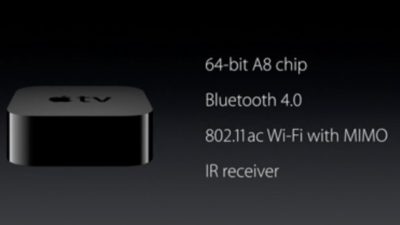
But like my mama always said, it’s what’s on the inside that counts. And inside the New Apple TV is packing a 64-bit A8 processor, currently found in the iPhone 6 Plus. It’s several times more powerful than the current Apple TV, and gives it the necessary horsepower to truck through the latest wave of graphically intense games. Does this mean that your Apple TV will become the premier spot to play the latest Call of Duty or Madden game? Most likely not. But for fans of casual or semi-casual gaming, the New Apple TV will be a pretty mean gaming machine.

It will support Bluetooth 4.0 (necessary to work with the all-new Siri remote),802.11ac WiFi with MIMO and come with either 32GB or 64GB of internal flash storage. None of this, however, is going to come cheap.

New Apple TV price

As expected, the 32GB will cost $149 (£129, AU$269) while the 64GB version will come in at $199 (£169, AU$349). It’s about three times the cost of the current Apple set-top box, but that price feels justified with all the new bells and whistles.

The only thing that would’ve sweetened the deal? A subscription to the purported cable alternative Apple has been working on for the past few months. This feature is likely to be coming, but we can now confirm that it missed the Apple TV announcement on September 9.

New Apple TV release date

So when can you get it? Apple launched the new Apple TV in over 80 countries on Monday October 26, and will expand to over 100 by the end of 2015.

New Apple TV competition

Looks like the new Apple TV isn’t the only shiny new set-top box on the market this holiday season. Recently Amazon launched a 4K version of the Amazon Fire TV, while Google has recently shipped out a Chromecast 2.

Finally, after techradar caught wind of the new Roku 4 thanks to a filing with the FCC in late September, Roku launched its stellar new streaming box at the tail end of October.

So far the consensus among reviewers is that the Chromecast 2 offers a faster response time and extremely affordable price tag if you can stand living without a user interface, while the the 4K Amazon Fire TV is great, but ultimately too dependent on a Prime subscription to do much good.

Conversely, the Roku 4 brings one of the best operating systems and universal search functions to the table, however the unit is noticeably louder and hotter than the Roku 3.

The first rumors of an Apple owned and operated cable service was given life on the web around the same time Sling TV made a splash in the US. The only problem with this plan is that Apple would need a lot of partners – FOX, NBC, ABC, Viacom, etc… – within a short time period.

The potential package in question would have a number of channels you know and love from cable but streamed over your Internet service for a lower monthly cost than traditional vendors like Sky, Virgin, Verizon or Time Warner Cable.

A service like that, exclusive to Apple TV, could be a huge differentiator and killer app for Cupertino. Whether Apple’s TV streaming dreams come to fruition – or actually exist at all – however, remains to be seen.

Apple pulls the plug on TV

After 10 years of research and development, Apple has officially stopped working on the fabled Apple television set, according to The Wall Street Journal.

According to a source familiar to the situation, because it was unable to add anything new to the world of flat-panels and 4K Ultra-HD TVs, Apple has thrown in the towel once and for all.

Apple is still expected to release both an updated version of the traditional set-top box as well as an over-the-top streaming service like Sling TV at its World Wide Developers Conference which starts on June 8.

The history of Apple TV

The first Apple TV launched back in 2006 and stuck out from the crowd by boasting its own hard drive and composite cables to hook up to then-new SD TV sets. It had a measly Intel Crofton Premium M processor and 256MB of DDR2 memory.

Version 2 ditched the internal storage for a better 802.11a/b/g/n Wi-Fi antenna, upgraded Apple A4 processor and favored streaming media over anything stored on physical drives. While some lamented the disappearance of a HDD, some appreciated the Apple TV’s smaller size as a result of the change.

Launching in 2012, Apple TV Version 3, the latest version of the Apple TV, didn’t offer much of an upgrade over its predecessor. It still streamed media and had a streamlined user-interface based on iOS (at that time it was iOS7). Of course the processor got a bump to the A5 to handle 1080p video and it finally doubled down on RAM to a solid 512MB.

Starting on March 9, 2015, the currently available Apple TV will drop to $69 (about £45, AU$90) and has first-dibs on HBO’s new standalone streaming service, HBO Now.

Have questions?

Get help from IT Experts/Microsofts Cloud Solutions Partner
Call us at: 856-745-9990 or visit: https://southjerseytechies.net/

South Jersey Techies, LLC is a full Managed Web and Technology Services Company providing IT Services, Website Design ServicesServer SupportNetwork ConsultingInternet PhonesCloud Solutions Provider and much more. Contact for More Information.

To read this article in its entirety click here.