Category Entertainment Technology

10 pieces of obsolete technology still in use today

Dial-up internet

Modem

The tech world moves fast, but not always as fast as you think. Obsolete technology has a tendency to hang on, and hang on strong. Here’s a list of 10 pieces of obsolete technology that are still alive and kicking, starting with a surprising one: dial-up internet.

Everyone remembers that screeching sound, followed by “You’ve got mail.”

The days of connecting to the internet with a 56K modem are over for most of us, but approximately three percent of Americans are holding out–that’s about 9.5 million people. Who are they–and do they know they could get online faster?

Image: iStock/Alexey Vedernikov

Dot matrix printers

Dot matrix printer

The use of dot matrix printers goes hand in hand with carbon-free, triplicate, continuous-feed paper. Both still have a use in the business world, which is why both have survived well past their point of obsolescence.

Image: iStock/sewer11

Fax machines

Fax machine

Find me a person who likes using a fax machine and I’ll show you someone who’s at least a bit insane.

Why the world still relies on paper faxes when digital scans are available is beyond my understanding. They aren’t more secure, they aren’t tamper-proof, and they’re just a waste of paper. Down with the fax!

Image: iStock/HSNPhotography

CRT screens

Several old video monitors

Encountering a CRT screen in the wild is kind of surprising, but it happens. They’re becoming harder and harder to find, and it’s nearly impossible to uncover a new one on the internet.

Maybe the next generation of youths will begin a CRT renaissance. After all, who doesn’t love vintage tech? For now, however, CRTs are just holding on in the dark corners of the world, silently (or buzzingly?) waiting for death.

Image: iStock/Sidney de Almeida

Floppy disks

Old diskettes

When it came out in May of this year that the Pentagon is still using floppy disks in computers that control nuclear ICBMs people laughed. When we then learned they were eight-inch floppy disks people were shocked.

If anyone would be using computer technology from the 1970s in 2016 it’s the government, right? What’s worse is that they spend billions a year operating and maintaining those systems. Let’s hope for a modern replacement before the outbreak of nuclear war.

Image: iStock/hroe

Cash registers

Old vintage cash register

The modern cash register is a bit more advanced than its early 20th century predecessor, but not by a lot. With the advent of iPads as POSes the cash register is facing extinction.

Some of the hippest, newest businesses are only armed with an iPad and a cash drawer, and those new systems are working great. Maybe in the next few years cash registers will be relegated to the same corners of the world where you now find CRTs.

Image: iStock/ivansmuk

Telegrams

Antique telegraph isolated.

You can still send a telegram in 2016. It’s not cheap, either: $18.95 gets you 100 words that will be hand delivered within three to five business days.

Telegrams may have been advanced in 1844, but in 2016 it’s hard to see a practical use for them. Sure, it’s more personal for a stranger to hand deliver a letter than it is to send a faceless email, but with the speed of the modern postal service you can just send a handwritten letter in the same amount of time.

Image: iStock/Larasoul

Beepers

Pager is communication old.

I know a few doctors, and some of them still carry beepers. Cell phones replaced beepers for most of us, but the medical community is still hanging on. An estimated 85 percent of hospitals still using the old black boxes, and they have their reasons.

Pager signals are stronger than cellular, the batteries last for weeks, and satellites beam pages to multiple towers, guaranteeing doctors get notified in emergency situations. Beepers will probably go away someday, but not until we figure out how to improve cellular reception.

Image: iStock/koyjira

Magnetic tapes

Close up of vintage audio tape cassette, isolated on white

Believe it or not, the sale of audio cassettes is actually increasing. I don’t see a reason to use a cassette in the age of digital media, but apparently lots of people do.

In the business world the debate still rages over the relevancy of tape backups. Cheap cloud storage is raising the question of tape practicality, but it will likely be awhile before they’re gone completely.

Image: iStock/BigJoker

COBOL

tech10

The COmmon Business-Oriented Language was invented in 1959, and it has been in use ever since. More efficient programming languages have come and gone since COBOL entered the world, yet it is the one performing over 70 percent of global business transactions in 2016.

Image: National Museum of American History

Have questions?

Get answers from Microsofts Cloud Solutions Partner!
Call us at: 856-745-9990 or visit: https://southjerseytechies.net/

South Jersey Techies, LL C is a full Managed Web and Technology Services Company providing IT Services, Website Design ServicesServer SupportNetwork ConsultingInternet PhonesCloud Solutions Provider and much more. Contact for More Information.

To read this article in its entirety click here.

Why you’ll never buy a 3D printer

Mattel’s ThingMaker 3D Printer and ThingMaker Design App is expected to ship later this year. Could a $300 3D printer capable of making hundreds of parts that can be assembled into toys finally place the technology next to the inkjet printer in the home?

The consumer 3D printer market, which has even tried to connect itself to video gaming, still seeks ‘killer app’

While 3D printer sales will experience healthy growth over the next four years, consumer machines remain a technology in search of a purpose, according to researcher IDC.

Read More

iPhone 7 rumors: Goodbye 16GB, hello 256GB and ‘Pro’ line

The new iPhone doesn’t come out until September, but that won’t stop the rumor mill from churning at a furious pace.

Now that WWDC is over, the iPhone 7 rumors are getting even louder, since its expected unveiling in September is probably the next time we’ll see Tim Cook on stage. Yes, that’s still a good while from now. To help keep track of all the scuttlebutt, we’re collecting every rumor we’ve heard so far—and every new one that crops up between now and the day Tim pulls the new iPhone out of his pocket. Then we’ll assess whether each rumor seems legit or absurd, and we’d love to hear your thoughts too. Sound off in the comments.

What’s the latest?

The rumor: Pricing specs for the upcoming iPhone 7 have allegedly leaked on Weibo, according to 9to5Mac. If believed, the specs show that Apple is looking to release a 256GB model of the iPhone 7 that will be the same price as the 128GB model of the current generation iPhone 6s. Furthermore, Apple would drop the meager 16GB models, offering instead 32GB, 64GB, and 256GB for the iPhone 7 and 32GB, 128GB, and 256GB for iPhone 7 Plus. And that’s not all, the rumor on Weibo has it that Apple is gearing up an iPhone 7 Pro line. This Pro model would be the only one to offer the dual-camera system that’s been rumored before, and a Smart Connector for accessories similar to the iPad Pro.

Plausible: Generation after generation, Apple has mostly retained the same pricing for iPhone models, so the fact that the 256GB iPhone 7 would cost the same as the current 128GB wouldn’t be unheard of. However, we’re a little skeptical that Apple would get rid of the 16GB base models, especially since iOS 10 seems to have been designed to optimize storage. And the Pro line would be an interesting addition, and would certainly make up for the fact that the iPhone 7 is rumored to be almost-identical to the 6s models. Apple is also making some strides in enterprise software, so an iPhone Pro would be a logical next-step.

Headphone jack after all?

The rumor: Via Engadget comes some component photos from Rock Fix, a smartphone repair shop in China. They allegedly show a dual-SIM tray, another shows a dual-lens camera for the larger Plus model, and curiously, there’s even an Lightning assembly that still has the headphone jack attached. People who need a lot of storage will be pleased to hear another photo shows SanDisk memory ships up to 256GB, which would be the most storage Apple’s ever offered in an iPhone.

Plausible? It’s hard to give much weight to photos of components, and as reported in the same Engadget article, conflicting rumors about the dual-lens camera surfaced within days. But it is plausible that these components could be for the iPhone 7—and we know plenty of people who would be thrilled if the new phone had a headphone jack after all.

New colors?

The rumor: It’s not easy being green, and iPhone owners might be starting to get envious of how many colors you can get an Android phone in. iPhones used to be pretty monochromatic, until Apple added gold and then an even brighter splash of color with last year’s rose gold hue (OK, OK, it’s pink). Japanese blog Macotara is reporting that Apple is switching it up this year, swapping the space gray color for navy blue instead.

Plausible? This is absolutely plausible. Apple’s iPhones have never been colorful, but the iPod touch comes in beautiful colored aluminum, and Apple has also set a tradition recently of switching up its Apple Watch bands to fit the season. One of the latest additions is a handsome navy Sport Band, and the Classic Buckle, Leather Loop, Modern Buckle, and two of the Hermès bands come in navy too. Navy looks great on both men and women, but we can’t help being a bit surprised it’s the “basic black” space gray color that’s rumored to be replaced.

A flat Home button?

The rumor:  Blurry, possibly fake spy photos from mobipicker (via 9to5Mac) seem to show a very flat-looking Home button. As in, maybe it’s not a button, maybe it’s just a touch-sensitive place you touch (and/or 3D Touch) instead of physically clicking it.

A fully flat Home button could have 3D Touch potential too.

Plausible? The Touch ID button got a lot faster between the iPhone 6 and 6s, but any button that physically clicks is another opportunity for hardware failure. With the rise of installment plans and the iPhone Upgrade program, we expect Apple to keep making little tweaks that make its phones more durable, so they’re turned in good enough shape to be possibly refurbished and resold. So yes, this is very plausible, and we think Apple could pull it off where the experience is the same, perhaps even using a little haptic feedback to make it feel like the button is clicking but it’s not—just like the Force Touch trackpad.

Read More

Wawa introduces free WiFi services

PHILADELPHIA – Wawa began offering free WiFi Tuesday for customers at its 700-plus stores.


The service is available through a collaboration between the retailer and Philadelphia-based Comcast, the companies said.

To access the free service, Comcast said, “customers should log on to the ‘xfinitywifi’ SSID in the list of available networks on their devices.”

The service includes public Xfinity WiFi for Wawa customers and private access WiFi for employees and vendors.

Wawa stores operate across the tri-state area, as well as in Maryland, Virginia and Florida. The firm’s WiFi service will be available outside of Comcast’s traditional service areas, the companies said.

Wawa noted it needed “a fast and reliable WiFi solution to enable a consistent in-store experience for its mobile application.” It also said the service allows customers “to take advantage of a free connection without having to rely on their cellular service.”

Bill Stemper, president of Comcast Business, said WiFi has become a vital service for companies looking to improve “the customer experience at their branch locations.”

Have questions?

Get answers from Microsofts Cloud Solutions Partner!
Call us at: 856-745-9990 or visit: https://southjerseytechies.net/

South Jersey Techies, LL C is a full Managed Web and Technology Services Company providing IT Services, Website Design ServicesServer SupportNetwork ConsultingInternet PhonesCloud Solutions Provider and much more. Contact for More Information.

To read this article in its entirety click here.

CES 2016: Fitbit launches $200 Apple Watch competitor

Step aside, Apple, there’s a new watch in town. At CES 2016, Fitbit unveiled the Blaze, a smartwatch that does things the Apple Watch can’t, and at a lower price point.

The basic utilitarian look of Fitbit is so last week, with today’s CES 2016 debut of Fitbit Blaze, a smart fitness watch with a color touchscreen that heralds in the next generation of the company’s popular fitness device line.

Fitbit Blaze does many of the same things as more expensive smartwatches, such as the Apple Watch, but it does it at a lower price point. The basic Fitbit Blaze comes with an elastomer band and will be available for retail sales in March 2016 with a $199 price tag. It tracks fitness and sleep stats and provides notifications for calls, texts, calendar alerts and music control. It’s compatible with Windows, iOS, and Android platforms.

One of the main features of the watch is how the bands are interchangeable to go from the gym to the office and out for the evening. Accessories will include additional elastomer bands for $29.95 each, leather bands for $99.95 each, and a steel link band for $129.95 each. The device is available for presale beginning today at Fitbit.com and tomorrow at various major retailers. For those who want to see the watch in person before ordering, on February 20 customers can go into Best Buy to try on the watch and pre-order.

“The product is about the balance of fitness and style. While it may look like a smartwatch, we think we’ve gotten it right. It has a distinct focus on fitness. That’s why we’re calling it a smart fitness watch. It puts fitness first,” said James Park, CEO and co-founder of Fitbit, at the CES 2016 press conference.

Fashion and style have long been a sore spot in the world of wearables and smartwatches. Because, even if a device has a stylish appearance, oftentimes it’s not feasible to wear the same product 24/7 for every occasion. The Fitbit Blaze eliminates this issue with the range of affordable interchangeable bands.

Fitbit Blaze includes many of the same features as previous Fitbit wearable fitness devices, such as all-day activity stats, but it also includes a color touchscreen, along with a partnership with FitStar for an onscreen workout. It also includes connected GPS for real-time exercise stats and PurePulse wrist-based heart rate tracking, which the company introduced last year.

The watch has a substantial battery life, lasting up to five days and nights, according to Fitbit Chief Business Officer Woody Scal.

Park said the Fitbit Charge, which was introduced last year, is the number one selling activity tracking device in North America, and the Fitbit Surge is the number one selling GPS tracking watch. On Christmas Day and the day after, Fitbit was the number one free app download.

“We are one of the larger technology IPOs of 2015. We are still trading about offering price which we think is rare. We’re pretty proud of that,” Park said.

Park took the opportunity at the press conference to point out how Fitbit is mentioned in the media, such as numerous photos with President Obama wearing a Fitbit Surge.

“For me it’s been really fun to see Fitbit mentioned on popular TV shows such as Big Bang Theory,” he said.

One of the biggest challenges that Fitbit faces is that its products have a 50% abandonment rate, compared to 6% for the Apple Watch. That makes the Blaze a strategically important move for Fitbit. The early reaction to the Blaze has been mixed as Fitbit’s stock dropped 13% following the announcement.

Have questions?

Get help from IT Experts/Microsofts Cloud Solutions Partner
Call us at: 856-745-9990 or visit: https://southjerseytechies.net/

South Jersey Techies, LL C is a full Managed Web and Technology Services Company providing IT Services, Website Design ServicesServer SupportNetwork ConsultingInternet PhonesCloud Solutions Provider and much more. Contact for More Information.

To read this article in its entirety click here.

5G Wireless is coming…But what is 5G?

Just five years after the first 4G smartphone hit the market, the wireless industry is already preparing for 5G.

Each of the four nationwide cell phone carriers, as well as smartphone chipmakers and the major network equipment companies are working on developing 5G network technology for their customers.

There are many significant hurdles that all the industry players have to clear before you’ll see a little 5G symbol next to the signal bars on your smartphone screen. For example, it has yet to be determined what 5G even means, let alone what it will look like and when it will get here.

But as consumers use up rapidly growing amounts of 4G bandwidth watching streaming videos on their phones, 5G will soon become a necessity. As telecom engineers work furiously to develop 5G technology, we’re getting a clearer picture of the who, what, where, when and why of 5G.

What is 5G?

Read More

New Apple TV release date, specs, price and news

For the fourth generation Apple TV, the possibilities are endless

Update: The new Apple TV is finally here and available to buy right now in all Apple Stores. Here’s the final pricing: $149 and $199 pricing for the 32GB and 64GB versions in the US respectively, £129 and £169 in the UK, while in Australia the cost is AU$269 and AU$349 for the different versions.
Apple TV


Original story below…

Three years of waiting for a major upgrade and six months of rumors have lead to this point: the new Apple TV, announced earlier in September at the company’s iPhone 6S event.

When it came time to think about the upgrade to the Cupertino company’s seminal streamer, it seems one Steve Jobs-ian point made it through the chopping board: the new Apple TV needs to be just as smart if its predecessor and just as easy to use. It needs to offer a slew of contemporary features but still remain relatively clean looking.

Perhaps unsurprisingly, the new Apple TV is all of those things.

Now, before you go down into the comments and leave a nasty retort, we know that “new Apple TV” is a fairly confusing name. But Apple bows to no numerical and/or logic system, and since the Apple TV has yet to see a true sequel until now, instead receiving iteration after iteration of internal upgrades, this is just the way the Apple peels.

It’s been about two years since the last minor change to the Apple TV and three since the last major one. Which, for a company that’s bound and determined to release a new iPhone every 12 months, seems a little strange that Apple’s popular streamer has been MIA since the iPhone 5.

But our patience has been rewarded, and Apple has delivered the next iteration of a great streaming device. It packs a faster processor than its predecessor, a great-looking UI, too. It has an all-new remote that comes with a built-in microphone and works with Siri, not to mention the fact that it doubles as a Wii-like motion game controller.

It has a sharp new OS – a hybrid of OSX and iOS – and comes with a loaded app store that Tim Cook says will usher in a new age of television. It’s ostentatious and bold vision packed into a tiny box. But that’s Apple for you.

Cut to the chase
What is it? The next generation of Apple’s set-top box, the Apple TV
When is it out? Monday October 26 2015 in over 80 countries worldwide
How much does it cost? The 32GB version will cost $149 (£129, AU$269) while the 64GB version will come in at $199 (£169, AU$349)
Why is it better? It has a faster processor, better interface, more apps, a Wii-esque remote and has voice search functionality

When WWDC 2015 came and went without an Apple TV announcement, we were a little disappointed. But when rumors started to circulate about the Cupertino company’s September 9 event, our hopes and dreams for a brand-new set-top box started to solidify into reality. It turns out it wasn’t all wishful thinking, either. Rumors of Apple’s next set-top box practically boiled over until most, if not all, of the Apple’s big secrets saw the light of day before the 9th. (You can find the key points highlighted in bold!)

New Apple TV user interface

User interfaces are absolutely crucial, and Apple built its reputation on putting together some of the sleekest, most easy-to-use pieces of software on the market. The new Apple TV harnesses that long tradition of doing things right and wildly improves the old model’s layout into something more modern.

The new UI is purposefully flat, with top-level boxes for music and movies on the iTunes store, your most used apps like Netflix and Hulu, as well as the recently added App Store – which is like to pack TV-optimized games alongside Apple Music and its music-streaming kin.

It’s all built on top of a new OS called tvOS that works like a hybrid of iOS and OSX. There are 11 million developers on the platform according to Apple senior vice president of Internet Software and Services, Eddy Cue, which means you can expect a ton of third-party apps available on the first day.

tvOS will support Siri and include universal search results that enable searches across multiple streaming video services as well as Apple’s iTunes Store. That means instead of searching for a movie on each individual app, you’ll be able to see a select number of services in every search (think Netflix, Amazon Prime Instant Video, Hulu, YouTube, Vimeo, etc).

New Apple TV remote

Also, we know that the New Apple TV will include an updated remote control (goodbye, boring aluminum IR remote) that operates over Bluetooth and features a mix of physical buttons and a touchpad.

Inside the remote, Apple looks to be packing in some Wii-esque motion sensors, which would make playing games on the App Store that require tilt easy. Speaking of Bluetooth, we’ve heard whispers that you might be able to connect any console-style controller made for iOS to the Apple TV if the new remote doesn’t do it for you.

Of course the remote will include an internal microphone so you can chat withSiri, meaning that the new Apple TV might be fully operable just with your voice.

Apps shown off so far that use the remote are a new-and-improved Crossy Road, Beats Sports – a Wii-like game from the Rock Band developers, MLB At Bat andApple Music. And for fans of the old-fashioned Home Shopping Network, Gilt will allow you to shop for deals from the comfort of your couch.

There are thousands more apps in the works, and techradar has confirmed with a handful of developers that even though the store looks sparse, many more apps are right around the corner.

New Apple TV hardware
apple-tv-specs

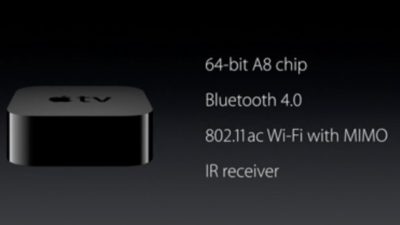
But like my mama always said, it’s what’s on the inside that counts. And inside the New Apple TV is packing a 64-bit A8 processor, currently found in the iPhone 6 Plus. It’s several times more powerful than the current Apple TV, and gives it the necessary horsepower to truck through the latest wave of graphically intense games. Does this mean that your Apple TV will become the premier spot to play the latest Call of Duty or Madden game? Most likely not. But for fans of casual or semi-casual gaming, the New Apple TV will be a pretty mean gaming machine.

It will support Bluetooth 4.0 (necessary to work with the all-new Siri remote),802.11ac WiFi with MIMO and come with either 32GB or 64GB of internal flash storage. None of this, however, is going to come cheap.

New Apple TV price

As expected, the 32GB will cost $149 (£129, AU$269) while the 64GB version will come in at $199 (£169, AU$349). It’s about three times the cost of the current Apple set-top box, but that price feels justified with all the new bells and whistles.

The only thing that would’ve sweetened the deal? A subscription to the purported cable alternative Apple has been working on for the past few months. This feature is likely to be coming, but we can now confirm that it missed the Apple TV announcement on September 9.

New Apple TV release date

So when can you get it? Apple launched the new Apple TV in over 80 countries on Monday October 26, and will expand to over 100 by the end of 2015.

New Apple TV competition

Looks like the new Apple TV isn’t the only shiny new set-top box on the market this holiday season. Recently Amazon launched a 4K version of the Amazon Fire TV, while Google has recently shipped out a Chromecast 2.

Finally, after techradar caught wind of the new Roku 4 thanks to a filing with the FCC in late September, Roku launched its stellar new streaming box at the tail end of October.

So far the consensus among reviewers is that the Chromecast 2 offers a faster response time and extremely affordable price tag if you can stand living without a user interface, while the the 4K Amazon Fire TV is great, but ultimately too dependent on a Prime subscription to do much good.

Conversely, the Roku 4 brings one of the best operating systems and universal search functions to the table, however the unit is noticeably louder and hotter than the Roku 3.

The first rumors of an Apple owned and operated cable service was given life on the web around the same time Sling TV made a splash in the US. The only problem with this plan is that Apple would need a lot of partners – FOX, NBC, ABC, Viacom, etc… – within a short time period.

The potential package in question would have a number of channels you know and love from cable but streamed over your Internet service for a lower monthly cost than traditional vendors like Sky, Virgin, Verizon or Time Warner Cable.

A service like that, exclusive to Apple TV, could be a huge differentiator and killer app for Cupertino. Whether Apple’s TV streaming dreams come to fruition – or actually exist at all – however, remains to be seen.

Apple pulls the plug on TV

After 10 years of research and development, Apple has officially stopped working on the fabled Apple television set, according to The Wall Street Journal.

According to a source familiar to the situation, because it was unable to add anything new to the world of flat-panels and 4K Ultra-HD TVs, Apple has thrown in the towel once and for all.

Apple is still expected to release both an updated version of the traditional set-top box as well as an over-the-top streaming service like Sling TV at its World Wide Developers Conference which starts on June 8.

The history of Apple TV

The first Apple TV launched back in 2006 and stuck out from the crowd by boasting its own hard drive and composite cables to hook up to then-new SD TV sets. It had a measly Intel Crofton Premium M processor and 256MB of DDR2 memory.

Version 2 ditched the internal storage for a better 802.11a/b/g/n Wi-Fi antenna, upgraded Apple A4 processor and favored streaming media over anything stored on physical drives. While some lamented the disappearance of a HDD, some appreciated the Apple TV’s smaller size as a result of the change.

Launching in 2012, Apple TV Version 3, the latest version of the Apple TV, didn’t offer much of an upgrade over its predecessor. It still streamed media and had a streamlined user-interface based on iOS (at that time it was iOS7). Of course the processor got a bump to the A5 to handle 1080p video and it finally doubled down on RAM to a solid 512MB.

Starting on March 9, 2015, the currently available Apple TV will drop to $69 (about £45, AU$90) and has first-dibs on HBO’s new standalone streaming service, HBO Now.

Have questions?

Get help from IT Experts/Microsofts Cloud Solutions Partner
Call us at: 856-745-9990 or visit: https://southjerseytechies.net/

South Jersey Techies, LLC is a full Managed Web and Technology Services Company providing IT Services, Website Design ServicesServer SupportNetwork ConsultingInternet PhonesCloud Solutions Provider and much more. Contact for More Information.

To read this article in its entirety click here.